
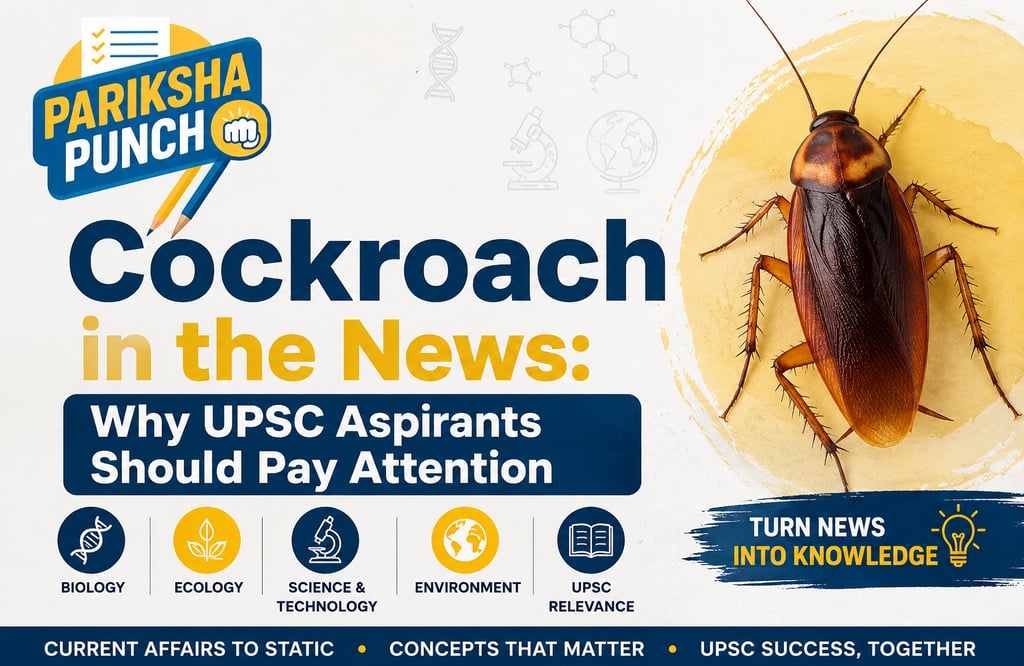
Cockroach in the News: Why UPSC Aspirants Should Pay Attention
A simple news headline can become a valuable UPSC learning opportunity. This blog explores the biological, ecological, and scientific significance of the cockroach, connecting current affairs with static concepts from the UPSC syllabus. Covering taxonomy, anatomy, metamorphosis, ecosystem functions, biomimicry, and likely Prelims and Mains relevance, it demonstrates how aspirants can transform everyday news into exam-oriented preparation. Learn how one organism can help revise multiple subjects while strengthening conceptual understanding for the Civil Services Examination.
CURRENT AFFAIRS
7/23/20265 min read
Turning Current Affairs into UPSC Preparation
UPSC preparation is not merely about reading newspapers—it is about identifying the static subjects hidden within current events. Whenever an unusual term, organism, place, or scientific concept appears in the news, it provides an opportunity to strengthen concepts from NCERTs and standard reference books.
Recently, the term "cockroach" has appeared in news headlines due to the name of a public movement. While the news itself belongs to the domain of current affairs, UPSC aspirants should shift their focus from the political context to the scientific, ecological, and environmental significance of the cockroach. This approach reflects the interdisciplinary nature of the Civil Services Examination, where current affairs are often connected with static knowledge.
Why Can Cockroach Become a UPSC Topic?
UPSC has consistently asked questions that begin with an organism or species mentioned in current affairs and then test concepts from:
Zoology
Ecology
Environment
Evolution
Biotechnology
Animal Physiology
Taxonomy
Biodiversity
Examples from previous years include questions related to bees, corals, vultures, bats, earthworms, fungi, cyanobacteria, and invasive species. Therefore, the appearance of "cockroach" in public discourse offers an excellent opportunity to revise multiple static topics.
Key Biological Features
Cockroaches possess several characteristics that make them representative members of Arthropoda.
Chitinous Exoskeleton
The hard outer covering made of chitin protects the body while providing support and reducing water loss.
Jointed Appendages
Like all arthropods, cockroaches possess segmented legs with movable joints that facilitate efficient locomotion.
Bilateral Symmetry
The body can be divided into two equal halves along a single plane.
Segmented Body
The body is divided into:
Head
Thorax
Abdomen
Open Circulatory System
Instead of blood flowing through closed vessels, cockroaches possess an open circulatory system where haemolymph bathes the organs directly.
Tracheal Respiration
Respiration occurs through spiracles connected to an internal network of tracheae rather than lungs.
Excretion
Excretion is carried out by Malpighian tubules, an important concept repeatedly tested in biology.
Development and Metamorphosis
One frequently tested concept is insect development.
Cockroaches undergo incomplete metamorphosis (hemimetabolous development).
Life Cycle:
Egg → Nymph → Adult
Unlike butterflies, there is no pupal stage.
This distinction often forms the basis of UPSC Preliminary questions.
Ecological Importance
Despite their negative reputation in urban environments, cockroaches perform several ecological functions.
1. Nature's Decomposers
Cockroaches feed on decaying organic matter including dead leaves, wood, and animal remains.
By breaking down organic waste, they contribute to nutrient recycling.
2. Maintaining Food Chains
Cockroaches serve as prey for numerous organisms including:
Birds
Lizards
Frogs
Spiders
Small mammals
Their removal from ecosystems could affect higher trophic levels.
3. Nutrient Cycling
The digestion of organic material by cockroaches returns nutrients to the soil, supporting plant growth and ecosystem productivity.
4. Soil Health
Some species contribute indirectly to soil aeration and organic matter decomposition, enhancing soil quality.
Importance in Scientific Research
Cockroaches are valuable laboratory organisms due to:
Easy maintenance
High reproductive rate
Well-understood anatomy
Adaptability
They are used in studies related to:
Neurobiology
Physiology
Behaviour
Comparative anatomy
Emerging Applications in Science & Technology
Modern scientific research has found surprising inspiration from cockroaches.
Bio-inspired Robotics
Engineers study cockroach movement to design robots capable of:
Entering narrow spaces
Navigating debris after disasters
Conducting search-and-rescue operations
Exploring hazardous environments
Such bio-inspired engineering is increasingly relevant in disaster management and robotics.
Waste Management Research
Researchers are examining the digestive systems and gut microorganisms of cockroaches to better understand the breakdown of complex organic materials. Insights from such studies may contribute to future innovations in waste processing and resource recovery.
Evolutionary Significance
Cockroaches are among the oldest surviving insect lineages.
Their evolutionary success is attributed to:
Broad dietary preferences
High adaptability
Efficient reproduction
Ability to occupy diverse habitats
Resilience to environmental change
This makes them useful examples when discussing evolution, adaptation, and natural selection.
Public Health Perspective
While cockroaches play beneficial ecological roles, some species commonly found in human dwellings can pose public health concerns.
They may:
Contaminate stored food
Trigger allergic reactions in susceptible individuals
Carry microorganisms mechanically on their body surfaces
Maintaining hygiene and proper waste management remains the most effective way to reduce infestations.
Relevance for UPSC Prelims
The topic can be linked with several recurring themes.
Biology
Animal Kingdom
Arthropoda
Insecta
Classification
Anatomy
Physiology
Metamorphosis
Environment
Decomposition
Food Chains
Food Webs
Nutrient Cycling
Ecosystem Functions
Science & Technology
Biomimicry
Robotics
Biotechnology
Bio-inspired Design
Evolution
Adaptation
Natural Selection
Evolutionary Survival
Relevance for UPSC Mains
Although UPSC Mains is unlikely to ask specifically about cockroaches, examples related to them can enrich answers in several General Studies papers.
GS Paper III
Science and Technology
Use as an example of:
Biomimicry
Robotics
Bio-inspired innovation
GS Paper III
Environment
Illustrate:
Ecosystem services
Decomposition
Nutrient recycling
Biodiversity
Essay Paper
Cockroaches can serve as an example while discussing:
Learning from nature
Innovation inspired by biology
Sustainable technologies
Human–nature interdependence
Adaptation and resilience
Adding relevant scientific examples often strengthens the analytical quality of essays.
Smart Revision Points
Remember these facts:
Kingdom – Animalia
Phylum – Arthropoda
Class – Insecta
Order – Blattodea
Chitinous exoskeleton
Open circulatory system
Tracheal respiration
Malpighian tubules
Bilateral symmetry
Segmented body
Incomplete metamorphosis
Important decomposer in ecosystems
Example of biomimicry in robotics
Useful model organism for scientific research
For a UPSC aspirant, every current affair should become an entry point into static learning. The recent appearance of the word "cockroach" in public discourse is less important than the scientific concepts it helps revise. From biological classification and ecology to biomimicry and technological innovation, a single organism connects multiple areas of the UPSC syllabus.
The lesson is clear: do not memorize headlines alone—identify the concepts behind them. This habit transforms day-to-day news into meaningful preparation for both the Preliminary and Mains examinations.
UPSC Prelims Practice Questions
Q1. With reference to cockroaches, consider the following statements:
Cockroaches belong to the Phylum Arthropoda.
They possess a chitinous exoskeleton.
They have a closed circulatory system.
Which of the statements given above is/are correct?
(a) 1 and 2 only
(b) 2 and 3 only
(c) 1 only
(d) 1, 2 and 3
Q2. With reference to the life cycle of cockroaches, which one of the following statements is correct?
(a) They undergo complete metamorphosis with a pupal stage.
(b) They undergo incomplete metamorphosis in which the nymph resembles the adult.
(c) Their development takes place entirely inside water.
(d) They reproduce only through parthenogenesis.
Q3. Which one of the following structures is primarily responsible for excretion in cockroaches?
(a) Nephridia
(b) Flame cells
(c) Malpighian tubules
(d) Green glands
Q4. Which of the following characteristics are generally associated with members of Phylum Arthropoda?
Jointed appendages
Chitinous exoskeleton
Bilateral symmetry
Open circulatory system
Select the correct answer using the code below.
(a) 1 and 2 only
(b) 1, 2 and 3 only
(c) 2, 3 and 4 only
(d) 1, 2, 3 and 4
Q4.Consider the following organisms:
Cockroach
Butterfly
Housefly
Which of the above undergo complete metamorphosis?
(a) 1 only
(b) 2 and 3 only
(c) 1 and 2 only
(d) 1, 2 and 3
Q5.With reference to ecosystem functioning, cockroaches contribute directly to which of the following?
Decomposition of organic matter
Nutrient cycling
Food chains
Select the correct answer using the code below.
(a) 1 only
(b) 2 and 3 only
(c) 1 and 3 only
(d) 1, 2 and 3
Q6. Which one of the following correctly represents the taxonomic hierarchy of the American cockroach (Periplaneta americana)?
(a) Animalia → Arthropoda → Insecta → Blattodea
(b) Animalia → Mollusca → Insecta → Blattodea
(c) Animalia → Arthropoda → Arachnida → Blattodea
(d) Animalia → Chordata → Insecta → Blattodea
Q7.Which one of the following is NOT a feature of insects such as cockroaches?
(a) Three pairs of legs
(b) Body divided into head, thorax and abdomen
(c) Two pairs of antennae
(d) Compound eyes
Q8.Cockroaches are increasingly studied in bio-inspired engineering because they are capable of
Moving efficiently through confined spaces.
Maintaining stability over uneven terrain.
Inspiring designs for search-and-rescue robots.
Which of the statements given above is/are correct?
(a) 1 only
(b) 1 and 2 only
(c) 2 and 3 only
(d) 1, 2 and 3
Q9. With reference to the circulatory system of cockroaches, consider the following statements:
Blood is confined entirely within blood vessels.
The circulating fluid is called haemolymph.
The heart pumps haemolymph into body cavities.
Which of the statements given above is/are correct?
(a) 2 and 3 only
(b) 1 and 2 only
(c) 1 and 3 only
(d) 1, 2 and 3
Q10.The success of cockroaches as one of the oldest surviving insect groups is primarily attributed to
Broad dietary adaptability
Ability to occupy diverse habitats
Efficient reproductive strategy
Select the correct answer using the code below.
(a) 1 only
(b) 2 and 3 only
(c) 1 and 3 only
(d) 1, 2 and 3
Q11. Which of the following statements regarding cockroaches is/are correct?
They belong to Order Blattodea.
They possess compound eyes.
They breathe through lungs.
Their body is covered by a chitinous cuticle.
Select the correct answer using the code below.
(a) 1, 2 and 4 only
(b) 1 and 3 only
(c) 2 and 3 only
(d) 1, 2, 3 and 4
Answers:
Q1. A
Q2. B
Q3. C
Q4. B
Q5. D
Q6. A
Q7. C
Q8. D
Q9. A
Q10. D
Q11. A
Pariksha Punch
Empowering you through right guidance and resources.
Our Policies
parikshapunch@gmail.com
7042341210
Contact Us
Quick Links
Mentoring @ Rs 11