
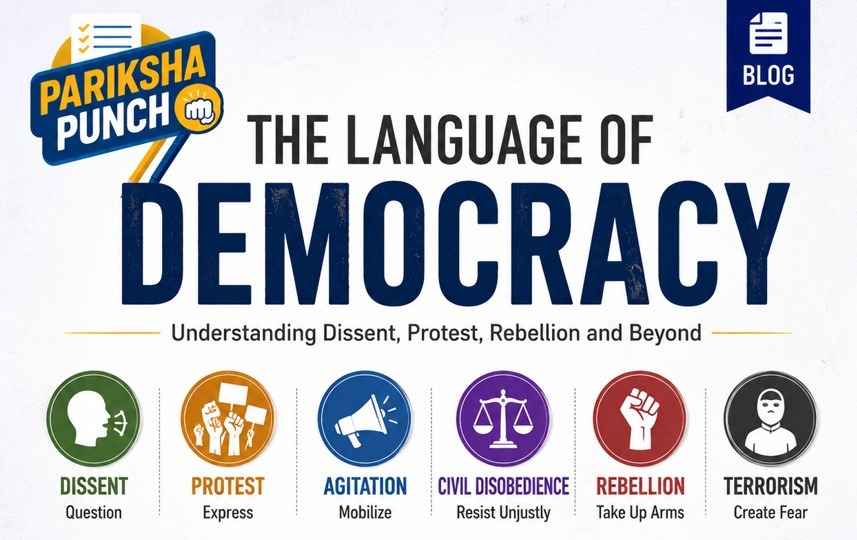
The Language of Democracy: Understanding Dissent, Protest, Rebellion and Beyond
In a vibrant democracy, words like dissent, protest, agitation, civil disobedience, rebellion, insurgency, and terrorism carry distinct constitutional, political, and ethical meanings. Confusing them often leads to flawed analysis in UPSC answers and public discourse. This blog explains these concepts with clarity, highlighting their legal, democratic, and moral dimensions while emphasizing the importance of constitutional values and intellectual integrity. A must-read for UPSC aspirants aiming to strengthen their understanding of Polity, Ethics, Governance, and Essay with conceptual precision.
UPSC BASICS
7/22/20264 min read
Why Every UPSC Aspirant Must Know the Difference
In UPSC preparation, words are not merely vocabulary—they are concepts with constitutional, political, ethical, and legal significance. Every year, newspapers are filled with terms such as dissent, protest, civil disobedience, agitation, rebellion, insurgency, and terrorism. Many aspirants use these terms interchangeably in their answers. Unfortunately, UPSC does not.
A candidate who understands the subtle distinction between these concepts demonstrates conceptual clarity, constitutional understanding, and intellectual maturity—qualities that distinguish a good answer from an average one.
This blog aims to decode these terms and explain why understanding them is essential not only for scoring higher marks but also for becoming a thoughtful future civil servant.
Why Does UPSC Care About Such Distinctions?
Imagine writing in an Ethics or Polity answer:
"People have the right to rebellion under Article 19."
This statement would be completely incorrect.
However, writing:
"The Constitution guarantees the right to peaceful dissent and protest subject to reasonable restrictions, but it does not protect violent rebellion or terrorism."
immediately reflects constitutional accuracy.
UPSC rewards precision, not approximation.
The Civil Services Examination tests whether candidates can distinguish between:
Rights and privileges
Criticism and anti-national activities
Peaceful resistance and violent extremism
Democratic participation and unlawful conduct
That is why conceptual clarity becomes indispensable.
Democracy Thrives on Dissent
Perhaps the most misunderstood word in public discourse today is dissent.
Dissent simply means expressing disagreement with an idea, policy, or authority.
A democracy without dissent gradually becomes an echo chamber.
Dr. B. R. Ambedkar repeatedly emphasized that constitutional methods and informed criticism are essential for democratic survival.
Similarly, the Supreme Court has observed that dissent is the safety valve of democracy.
Examples include:
questioning a government policy
criticizing a judicial judgment
opposing a legislative proposal
expressing disagreement through articles or speeches
Dissent does not seek to destroy democracy.
It strengthens democracy by ensuring accountability.
Protest: Dissent in Action
While dissent is an opinion, protest is the public expression of that opinion.
Protests may take several forms:
rallies
marches
sit-ins
candlelight vigils
demonstrations
signature campaigns
The objective is not violence but persuasion.
Article 19 of the Constitution protects peaceful assembly, making peaceful protest a legitimate democratic instrument.
India's democratic history is full of examples:
JP Movement
Anti-Corruption Movement
Right to Information campaign
Farmers' movements
Environmental movements
Not every protest is justified.
Not every protest is unjustified.
Its legitimacy depends upon constitutional methods and public interest.
Criticism Is Not Anti-National
One of the greatest misconceptions in public discourse is equating criticism with disloyalty.
A mature democracy welcomes criticism.
Constructive criticism identifies shortcomings and recommends improvements.
For example,
criticizing:
environmental policy
education reforms
budget allocations
administrative inefficiency
does not imply opposition to the nation.
Rather, it reflects democratic participation.
As George Orwell observed,
"If liberty means anything at all, it means the right to tell people what they do not want to hear."
Civil Disobedience: Breaking Law to Uphold Justice
One of India's greatest contributions to political philosophy is the doctrine of Civil Disobedience.
Mahatma Gandhi transformed resistance by insisting that:
unjust laws may be peacefully violated,
but violence can never be justified.
Civil disobedience is characterized by:
openness
non-violence
willingness to accept punishment
moral persuasion
The Salt March remains one of history's finest examples.
Civil disobedience seeks to change unjust laws—not destroy the constitutional order.
Agitation and Mass Mobilisation
An agitation is generally broader than a protest.
It involves continuous public mobilisation over a prolonged period.
Examples include:
student movements
reservation movements
linguistic movements
environmental campaigns
Agitations may include:
demonstrations
public meetings
awareness campaigns
symbolic resistance
While peaceful agitation remains democratic, violence during agitation changes its legal character.
Resistance and Defiance
Resistance means opposing an action, authority, or injustice.
Resistance may be:
legal
constitutional
political
social
Defiance, however, implies openly refusing to obey authority.
The distinction lies in intention.
Resistance may still operate within constitutional limits.
Defiance often challenges authority directly.
When Opposition Turns Violent
The democratic spectrum changes completely once violence becomes the primary method.
Terms like:
revolt
rebellion
insurrection
insurgency
cannot be casually interchanged.
Revolt
Usually a sudden uprising against authority.
Often short-lived.
Example:
The Royal Indian Navy Revolt (1946).
Rebellion
A larger and organized armed resistance against established authority.
Example:
The Revolt of 1857 is frequently referred to as India's First War of Independence as well as the Great Rebellion.
Insurrection
An organized armed uprising intended to overthrow authority.
Generally more coordinated than a simple revolt.
Insurgency
A prolonged armed movement against the State for political, ideological, or territorial objectives.
Examples include:
Left Wing Extremism
separatist insurgencies
Insurgency involves sustained conflict rather than isolated violence.
Extremism and Terrorism
Perhaps no distinction is more important.
Extremism refers to holding radical ideological beliefs.
Not every extremist becomes violent.
Terrorism begins where violence against civilians becomes a deliberate strategy.
Its purpose is not merely physical destruction.
It seeks to create:
fear
insecurity
psychological pressure
Unlike democratic protest, terrorism rejects constitutional methods altogether.
What Does the Constitution Protect?
A civil servant must clearly understand constitutional boundaries.
Protected
✔ Freedom of Speech
✔ Peaceful Assembly
✔ Association
✔ Peaceful Protest
✔ Democratic Dissent
Not Protected
✘ Armed Rebellion
✘ Terrorism
✘ Violent Insurrection
✘ Activities threatening sovereignty and integrity of India
This distinction frequently appears in UPSC Mains and Interview discussions.
Why Intellectual Integrity Matters
One hallmark of a future civil servant is intellectual integrity.
It means being honest with facts, even when they challenge personal beliefs.
An intellectually honest aspirant:
distinguishes disagreement from disloyalty,
separates criticism from sedition,
understands constitutional morality,
avoids emotional reasoning,
uses precise terminology.
UPSC increasingly rewards candidates who analyse issues with balance rather than ideology.
How These Concepts Appear in UPSC
These terms are relevant across multiple papers:
GS Paper II
Fundamental Rights
Freedom of Speech
Civil Society
Pressure Groups
Governance
Democracy
GS Paper III
Internal Security
Left Wing Extremism
Terrorism
Radicalisation
Public Order
Ethics
Constitutional Morality
Courage of Conviction
Integrity
Public Accountability
Essay
Themes involving democracy, liberty, justice, nationalism, governance, and citizen participation often require precise conceptual distinctions.
A Simple Memory Framework
Think of these concepts as a ladder:
Disagreement
→ Criticism
→ Dissent
→ Protest
→ Civil Disobedience
→ Agitation
→ Resistance
→ Revolt
→ Rebellion
→ Insurgency
→ Terrorism
The higher you move on this ladder, the greater the departure from constitutional methods.
Understanding this progression prevents conceptual confusion in UPSC answers.
Final Thoughts
UPSC is not merely testing how much you know—it is evaluating how clearly you think.
A future civil servant must appreciate that democracy is sustained through dialogue, accountability, and constitutional morality. Knowing the difference between dissent and rebellion, criticism and extremism, or civil disobedience and terrorism is not just an academic exercise—it reflects the maturity expected from those who aspire to serve the nation.
At Pariksha Punch, we believe that high-quality UPSC preparation begins with conceptual clarity. The difference between an average answer and a top-scoring answer often lies in the correct use of a single word. Master the language of governance, develop intellectual integrity, and cultivate analytical precision—because in the Civil Services Examination, words carry weight, and understanding their true meaning can make all the difference.
Pariksha Punch
Empowering you through right guidance and resources.
Our Policies
parikshapunch@gmail.com
7042341210
Contact Us
Quick Links
Mentoring @ Rs 11