
UPSC Essay Writing: Breaking the Myths and Understanding What the Examiner Really Wants
This article demystifies UPSC essay writing by debunking common myths and explaining what the examiner truly evaluates—clarity of thought, relevance, balanced analysis, structured presentation, and effective expression. It helps aspirants move beyond fear, rigid templates, and misconceptions to adopt a realistic, practice-oriented essay strategy aligned with UPSC expectations.
ESSAY
12/22/20254 min read
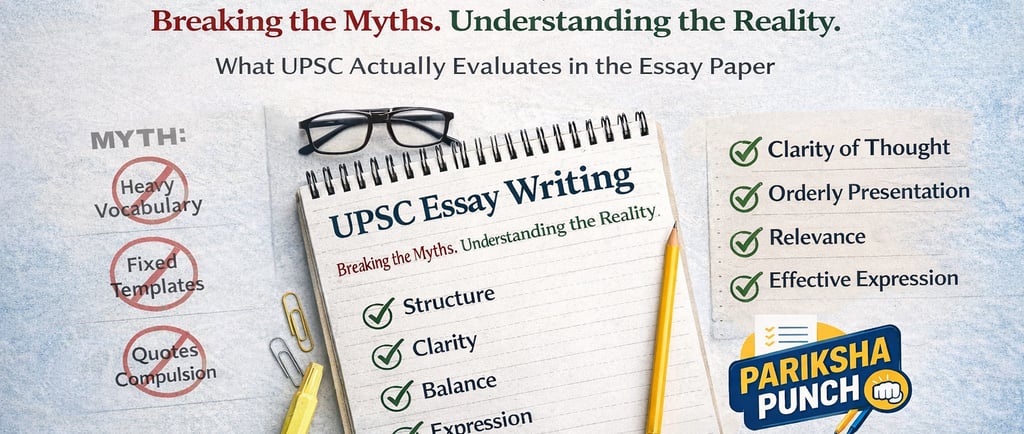
Essay writing is one of the most decisive yet misunderstood components of the UPSC Civil Services Examination (CSE). Despite carrying substantial weightage, it is often approached with anxiety, misinformation, and rigid assumptions. As a result, many aspirants underperform not due to lack of knowledge, but due to flawed understanding of UPSC essay expectations.
As per the official UPSC essay syllabus instructions,
“Candidates may be required to write essays on multiple topics. They will be expected to keep closely to the subject of the essay, to arrange their ideas in an orderly fashion, and to write concisely. Credit will be given for effective and exact expression.”
These instructions clearly indicate that the UPSC essay paper evaluates clarity of thought, relevance, structure, coherence, and precision of expression, rather than decorative language or rigid formats.
This blog systematically debunks common myths related to language, introduction, body structure, content, conclusion, and overall essay strategy, and replaces them with a realistic understanding of what UPSC actually expects.
Myths Related to Language & Expression in UPSC Essays
Myth: Essay writing requires exceptional literary English and advanced vocabulary
Reality:
UPSC does not evaluate literary brilliance. It evaluates effective and exact expression, as clearly stated in the syllabus. Simple, clear, and grammatically correct language communicates ideas more effectively than complex vocabulary.
In fact, many high-scoring UPSC essays are written in plain, accessible English that reflects clarity of thought.
Myth: Using complex theories and jargon always improves the quality of the essay
Reality:
Unnecessary jargon often reduces clarity and coherence. Theories are useful only when they directly strengthen an argument and are clearly explained in simple terms. UPSC values understanding and relevance, not mechanical insertion of academic terminology.
Myths Related to the Introduction of an Essay
Myth: A fixed introduction template can be used for all essay topics
Reality:
UPSC essay topics vary widely - philosophical, social, economic, political, and ethical. Each requires a context-specific introduction. Rigid templates often lead to forced and superficial openings that fail to address the core demand of the topic.
Myth: An introduction must always begin with a quote to appear impressive
Reality:
Quotes are optional. An introduction without a quote can be equally impactful if it defines key terms, sets context, and establishes direction.
A forced or irrelevant quote can weaken the essay’s first impression.
Myth: Repeating the essay topic in different words is sufficient as an introduction
Reality:
Merely paraphrasing the topic does not demonstrate understanding. A good introduction interprets the topic, identifies its scope, and signals the analytical direction of the essay.
Myth: The introduction is less important than the body of the essay & therefore can be skipped.
Reality:
The introduction is indispensable part of essay structure and frames the examiner’s expectations. A weak introduction often affects the evaluation of the entire essay, regardless of content quality.
Myths Related to Body Structure & Organization
Myth: An essay must strictly follow a rigid format to score well
Reality:
UPSC evaluates orderly arrangement of ideas, not rigid formats. Structure should emerge from logical progression, not mechanical templates. Flexibility based on topic demand is crucial in UPSC essay writing.
Myth: Writing a longer essay automatically guarantees higher marks
Reality:
There is no reward for length alone. Examiners value relevance, balance, and coherence. Long essays often suffer from repetition and dilution of arguments. Essay in UPSC should be written in a specified word limit i.e 1000-1200 words.
Myth: Writing speed is more important than planning and structuring the essay
Reality:
Without planning, speed leads to disorganized content. Effective essay writing involves brainstorming, structuring, and then writing. Good planning actually saves time during execution.
Myth: Diagrams, flowcharts, or headings reduce the seriousness of an essay
Reality:
When used sparingly and appropriately, headings or simple diagrams improve readability and demonstrate structured thinking - an important parameter in UPSC evaluation.
Myths Related to Body Content & Analysis
Myth: Essays do not require data, examples, or factual grounding
Reality:
Abstract arguments must be supported with examples, constitutional values, policies, case studies, or real-life illustrations.
UPSC essays reward balanced integration of static knowledge and current affairs.
Myth: Only famous theories, thinkers, scholars, or examples should be cited
Reality:
Relevance matters more than reputation. Contemporary examples, the Indian context, and well-explained ideas are often more effective than forced name-dropping.
Myth: Essays should avoid counter-arguments to maintain a strong stance
Reality:
Acknowledging counter-arguments (Anti-thesis) and addressing them rationally reflects analytical maturity and balance, both crucial in UPSC essays.
Myth: Philosophical essay topics are risky and should be avoided
Reality:
Philosophical essays test clarity of interpretation, ethical reasoning, and real-world linkage, not academic philosophy. When handled systematically, they can be highly scoring.
Myths Related to the Conclusion of an Essay
Myth: The conclusion should merely summarise what has already been written
Reality:
A strong conclusion synthesizes arguments and provides closure with insight, rather than repetition.
Myth: A conclusion must always contain a quote to appear impactful
Reality:
Impact comes from vision, coherence, and optimism, not compulsory quotations.
Myth: Introducing forward-looking ideas in the conclusion is not allowed
Reality:
Future-oriented perspectives, solutions, and reformative suggestions align well with UPSC’s focus on constructive and solution-based thinking.
Myth: Conclusions can be rushed or skipped if time is insufficient
Reality:
The conclusion leaves the final impression. A weak ending can significantly reduce the overall impact of an otherwise good essay.
VI. Other Common Myths about UPSC Essay Preparation
Myth: Essay writing is an inborn talent and cannot be improved
Reality:
Essay writing is a learnable skill that improves with practice, feedback, and reflection.
Myth: Essay preparation is completely separate from General Studies
Reality:
Essay writing is an application of GS knowledge, requiring synthesis across subjects like polity, economy, ethics, society, and governance.
Myth: Essay evaluation is entirely subjective and examiner-dependent
Reality:
While subjectivity exists, evaluation follows consistent parameters - relevance, structure, balance, clarity, and expression. Well-written essays score consistently well.
Myth: Essay preparation should begin only after completing the entire syllabus
Reality:
Essay preparation should run parallel to GS preparation. Early practice improves articulation and integration skills.
The UPSC essay paper is not a test of language ornamentation or rigid templates. It is a structured assessment of clarity of thought, balanced analysis, orderly presentation, and effective expression, as clearly stated in the official syllabus. Once myths are removed, essay writing becomes a logical, manageable, and even enjoyable component of UPSC preparation.
Pariksha Punch
Empowering you through right guidance and resources.
Our Policies
parikshapunch@gmail.com
7042341210
Contact Us
Quick Links
Mentoring @ Rs 11