
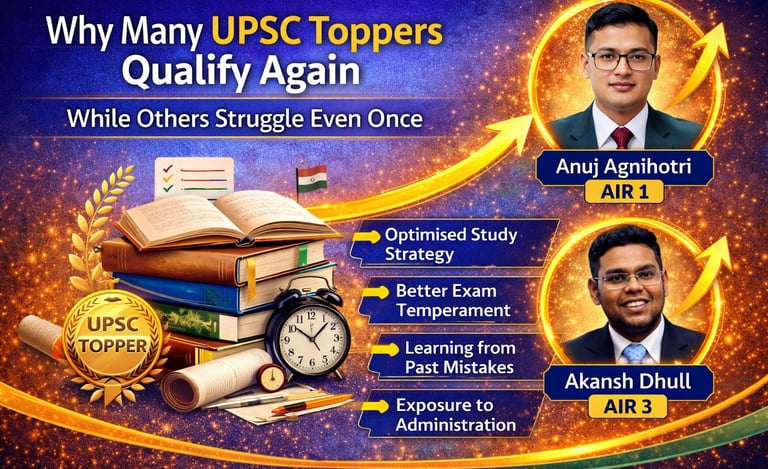
Why Many UPSC Toppers Qualify Again — While Others Struggle Even Once
This blog examines a recurring pattern in the Civil Services Examination conducted by the Union Public Service Commission (UPSC)—many candidates who qualify once often succeed again in subsequent attempts, while others struggle for years to clear it even once. Using examples like Anuj Agnihotri (AIR 1) and Akansh Dhull (AIR 3), the article explains how confidence, better understanding of the exam pattern, refined study strategy, exam temperament, and exposure to administrative thinking help repeat qualifiers sustain success.
UPSC BASICS
3/15/20265 min read
The Civil Services Examination conducted by the Union Public Service Commission (UPSC) is widely regarded as one of the most demanding competitive examinations in India. Every year, lakhs of aspirants prepare with dedication, yet only a very small fraction manage to secure a place in the final list.
A striking pattern often observed in the results is that several candidates who qualify once tend to qualify again in subsequent attempts, sometimes even improving their ranks. Recent examples include Anuj Agnihotri securing All India Rank 1, CSE 2025 and Akansh Dhull securing All India Rank 3, CSE2025, both of whom demonstrated how a refined preparation approach can lead to remarkable success in the exam again and again. Such examples reinforce an important observation: candidates who understand the exam deeply often continue to perform well in subsequent attempts.
At the same time, many aspirants struggle for years without being able to clear the examination even once. This creates an important question: Why does success in UPSC often repeat for some candidates while remaining extremely difficult for many others?
The answer lies in a combination of psychological transformation, strategic preparation, exam familiarity, and deeper understanding of administrative thinking.
The Psychological Advantage After the First Success
One of the most significant transformations occurs at the psychological level. For a first-time aspirant, the UPSC examination often appears unpredictable and intimidating. There is uncertainty about the level of preparation required, the nature of questions, and the expectations in the mains examination and interview.
However, once a candidate successfully clears the exam, this uncertainty largely disappears. The aspirant gains a strong sense of confidence and clarity. The mental barrier of “Can I crack this exam?” is replaced by the belief that “I already know how this exam works.” This psychological shift reduces stress and allows the candidate to approach the examination with a calm and focused mindset.
Deeper Understanding of the UPSC Pattern
The Civil Services Examination conducted by the Union Public Service Commission (UPSC) is widely regarded as one of the most demanding competitive examinations in India. Every year, lakhs of aspirants dedicate years of preparation to this exam, yet only a small percentage manage to succeed. Interestingly, UPSC results often reveal a recurring pattern: several candidates who qualify once tend to qualify again in subsequent attempts, sometimes even improving their rank or service preference.
At the same time, many aspirants find it extremely difficult to clear the examination even once despite multiple attempts. This pattern raises an important question: why does success in UPSC often repeat for some candidates while remaining elusive for many others? The answer lies in a combination of psychological confidence, strategic preparation, experience with the exam pattern, and deeper exposure to administrative thinking.
Optimised Study Strategy
Another key factor behind repeat success is the evolution of a well-optimized preparation strategy. During earlier attempts, candidates experiment with multiple sources, coaching materials, and study methods. Over time, they learn what actually works for the examination.
By the time they reappear for the exam, most repeat qualifiers adopt a minimalist but revision-focused approach. They rely on limited, trusted sources and emphasize repeated revision rather than collecting new materials.
Their preparation becomes more efficient because they are able to interlink concepts across subjects, a skill that is extremely valuable in UPSC where questions often cut across traditional disciplinary boundaries.
Stronger Content Retention Through Revision
Candidates who qualify the examination once usually have already completed multiple rounds of revision of core subjects. This repeated engagement with the syllabus builds strong conceptual clarity and long-term memory.
As a result, they are able to recall facts, arguments, and examples more quickly during the exam. This becomes particularly useful in the prelims stage, where rapid recall and precise judgement determine whether an answer is attempted or skipped.
Improved Exam Temperament
UPSC is not only a test of knowledge but also a test of temperament. Many aspirants struggle during the exam due to anxiety, overthinking, or poor time management.
Candidates who have already cleared the exam possess a major advantage: they are familiar with the pressure and rhythm of the examination environment. They know how to maintain composure, how to manage time across sections, and how to handle difficult questions without panic.
This calm and confident approach often leads to better performance in both prelims and mains.
Learning from Previous Mistakes
Another important advantage of repeat qualifiers is their ability to analyse their past performance objectively. After each attempt, UPSC provides marksheets that clearly reveal areas of strength and weakness.
Candidates who qualify once are often able to identify gaps in their earlier preparation—whether in prelims accuracy, answer writing, essay structuring, or optional subject performance. They then focus on targeted improvements rather than repeating the same preparation cycle.
Exposure to the Working of Administration
An additional and often overlooked factor is the exposure some repeat qualifiers receive to the functioning of administration. Candidates who join the civil services and later reappear for a better rank or preferred service often gain the opportunity to observe administrative processes closely.
This exposure helps them realise that the skills required to clear the UPSC examination are closely aligned with the skills required in governance and public administration. Qualities such as positive problem-solving orientation, strong comprehension ability, attention to detail, analytical thinking, and precision in decision-making are central both to the examination and to administrative functioning.
Understanding how these qualities operate in real administrative contexts reinforces the importance of these skills during preparation. As a result, such candidates approach the exam with a deeper appreciation of the kind of thinking UPSC expects.
Why Many Aspirants Struggle to Qualify Even Once
While repeat success becomes easier for some candidates, many aspirants find it extremely difficult to clear the exam even once. This often happens due to structural issues in preparation rather than lack of effort.
Some common challenges include:
Studying from too many sources without sufficient revision
Lack of clarity about the demand of the examination
Inadequate practice of answer writing for mains
Weak strategy for prelims and poor risk management in MCQs
Psychological pressure and self-doubt
Without addressing these structural issues, aspirants may continue preparing for years without being able to cross the first stage of the examination.
Lessons for Aspirants
The pattern of repeat qualifiers in UPSC highlights an important insight: success in this examination is largely process-driven. Once a candidate develops the right preparation system—focused sources, strong revision habits, clear understanding of PYQ trends, and effective exam temperament—the probability of success increases significantly.
Click Here For UPSC - Prelims PYQs (2025 - 2014)
For most aspirants, the biggest challenge is not maintaining success but crossing the first barrier of qualification. Once that barrier is crossed, the preparation ecosystem, confidence, and experience begin to work in their favour.
The tendency of many UPSC candidates to qualify repeatedly reflects the cumulative advantage created by experience, strategic preparation, and psychological confidence. Success in UPSC often creates a positive preparation cycle in which knowledge, exam skills, and administrative thinking reinforce one another.
For aspirants preparing today, the key takeaway is clear: focus on developing clarity of strategy, disciplined revision, analytical thinking, and exam temperament. These qualities not only help in clearing the UPSC examination but also form the foundation of effective public administration.
Once the preparation process is mastered, success in the examination becomes far more achievable.
Pariksha Punch
Empowering you through right guidance and resources.
Our Policies
parikshapunch@gmail.com
7042341210
Contact Us
Quick Links
Mentoring @ Rs 11